


New information
Promoting Multicultural Coexistence through “Easy Japanese”: Staff Training in Tone Town
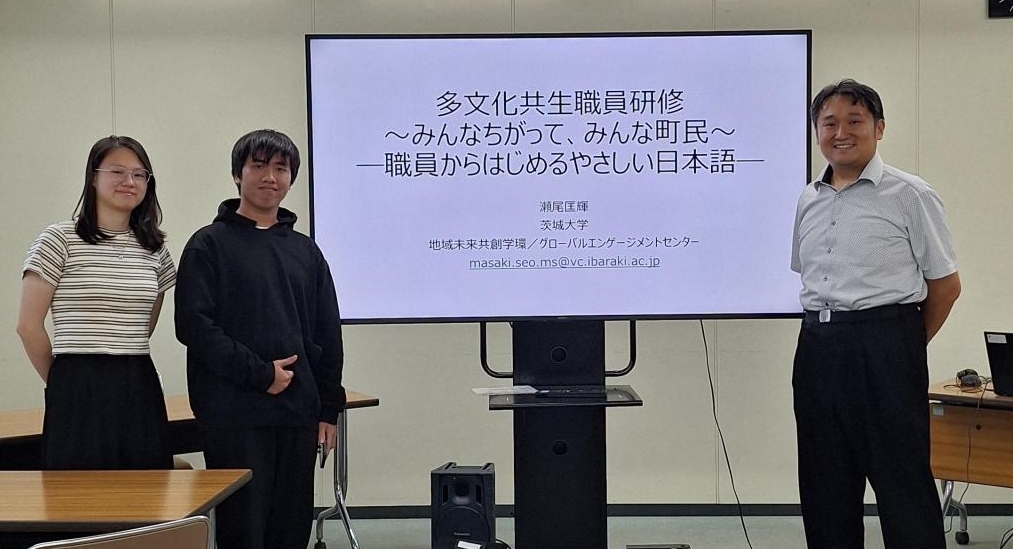
On June 26, 2026, Tone Town held a staff training workshop titled “Multicultural Coexistence Training for Staff: Everyone Is Different, Everyone Is a Resident.” The session was led by Associate Professor Masaki Seo of the Global Engagement Center at Ibaraki University. The training aimed to help municipal staff learn the principles and practical applications of “Easy Japanese” as a means of improving communication.
In recent years, Tone Town has seen an increase in the number of international residents, including international students, partly due to the presence of universities and Japanese language schools in the area. As a result, challenges related to communication—such as difficulties in conveying information and mutual understanding due to differences in language and culture—have become more apparent. This training was organized to enhance the quality of public services and to promote a community where everyone can live with a sense of security and inclusion.
The training was conducted in two sessions, morning and afternoon, with staff members from various departments in attendance. One of the key features of the program was its workshop-based format, rather than lecture-only instruction. Participants worked in groups to engage in role-play activities based on typical scenarios at municipal service counters, practicing how to rephrase expressions into “Easy Japanese.” In addition, participants worked on rewriting actual administrative documents into clearer, more accessible language. Through these exercises, staff members reconsidered technical terminology and administrative expressions, reflecting on their own language use in order to make it more understandable for diverse audiences.
Two exchange students from Ibaraki University (from Indonesia and Taiwan) also participated in the training. During the role-play activities, they took on the role of international residents and engaged in face-to-face interactions with staff. Furthermore, in the document-rewriting exercises, they provided valuable feedback from their perspectives, pointing out expressions that were difficult to understand and suggesting clearer alternatives. Participants commented that they were able to experience firsthand the challenges of communication and gained a deeper awareness of the importance of considering others’ perspectives. For the exchange students as well, the training provided a meaningful opportunity to connect their own experiences with the local community.
This initiative represents a practical example of collaboration between the university and the local community to promote multicultural coexistence. Ibaraki University will continue to work with local partners to contribute to the creation of an inclusive society where everyone can live with confidence and dignity.